Repair line, Viking repair
Viking refrigerator repair, traced along the path of heat
No refrigerator manufactures cold. It hauls warmth away from your groceries and releases it into the room. Whenever a built-in Viking turns lukewarm, grows frost or leaves a puddle, something along that route has stalled, and pinpointing where is the entire diagnosis.
Rated 4.8 out of 5 by clients, 143 reviews How reviews work
Six signs the heat is not getting out
Each sign below marks a different stretch of the route heat takes from your shelves to the room.
-
The fresh food side is warm while the freezer stays frozen
Likely causeAn evaporator fan that quit, a coil buried in frost from a defrost fault, or a sensor misreading the cabinet.
-
Thick frost or ice coats the back wall or surrounds the fan
Likely causeA failed defrost heater, defrost thermostat or defrost control, or a worn gasket admitting moist kitchen air.
-
A puddle forms by the toe kick
Likely causeIce blocking the defrost drain, a split catch pan underneath, or a dripping water line feeding ice production.
-
The ice bin has stopped filling
Likely causeIce inside the fill tube, an inlet valve stuck shut, or the ice maker's own module.
-
The compressor hums without ever taking a break
Likely causeA dusty condenser coil or a dead condenser fan motor forcing the system to labor, or occasionally a sealed-system fault.
-
New buzzing, rattling or scraping
Likely causeA fan blade catching on ice, a worn fan motor, or less often the compressor.
Quick answer · first stop
Viking fridge warm but freezer still cold: what's going on?
Your fresh food compartment relies on fans, defrost and sensors that can quit while the freezer carries on. Expect a stalled evaporator fan, a coil smothered in frost after defrost failed, or a thermostat or sensor reporting wrongly. Some built-ins even run a separate cooling system for each section, another reason to test before replacing parts.
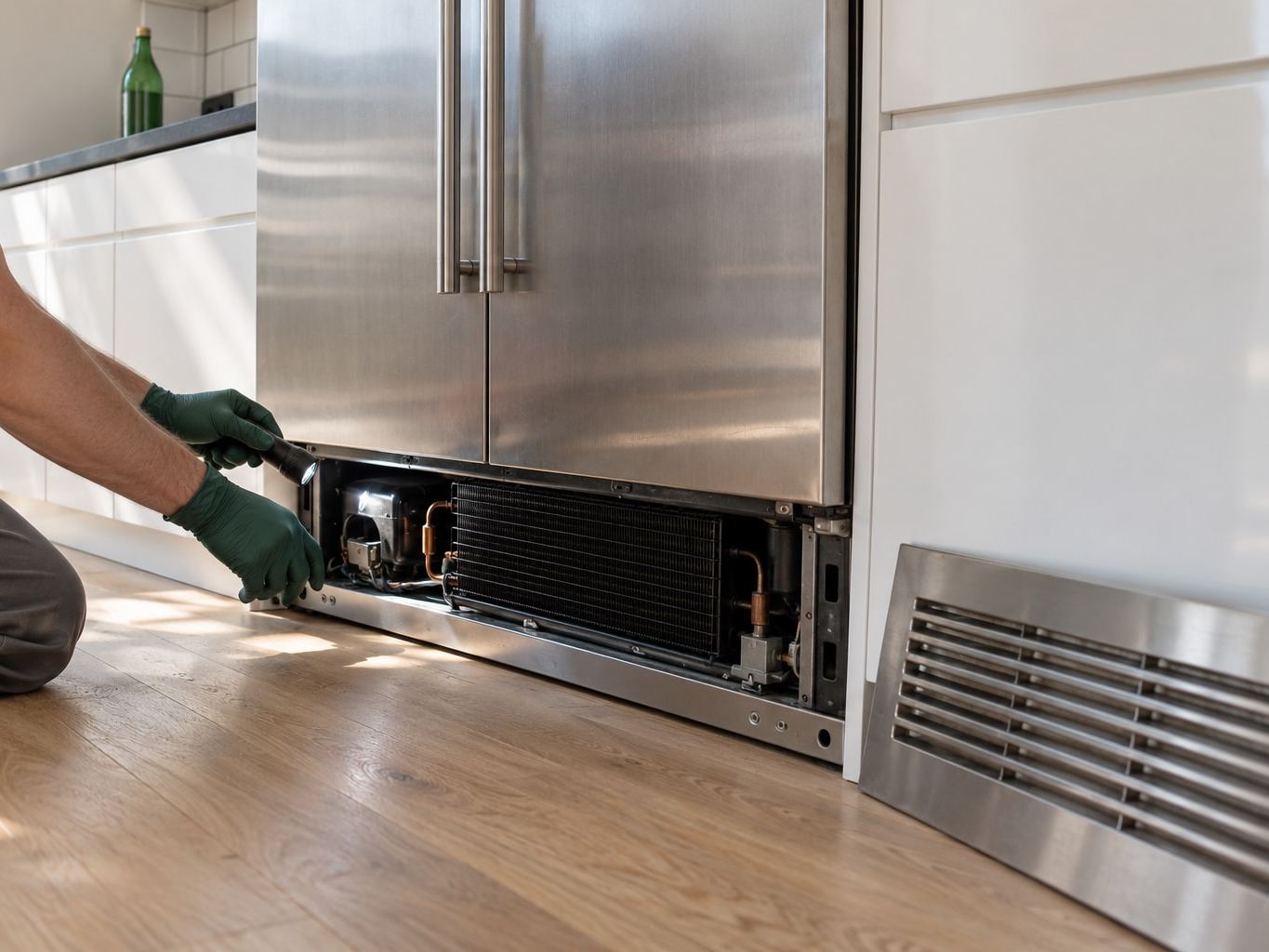
Follow the heat: where a built-in fridge breaks
Inside the cabinet, an evaporator coil soaks up warmth and a small fan sweeps chilled air across your shelves. Refrigerant carries that warmth to the compressor, which pumps it onward to the condenser coil, where a second fan pushes it into the kitchen. Every complaint on this page is a stall somewhere in that loop.
On a built-in Viking the condenser hides behind a front grille, quietly collecting lint, pet hair and kitchen grease. Once that coil clogs or its fan slows, warmth cannot escape, the compressor runs longer and longer, and the cabinet warms regardless. One Viking refrigerator in our case notes ran nonstop yet could not hold temperature; a fresh condenser fan motor plus a thorough coil cleaning settled it.
Defrost is the quiet partner in the loop. A heater warms the evaporator coil on a schedule so frost never chokes the airflow. If that heater, its thermostat or its control fails, ice accumulates until the fan has nothing to push through, and the fresh food side warms first. Sensors and the thermostat decide when everything runs, so one bad reading can make a healthy system work too little or too hard.
The sealed system, meaning compressor, coils and refrigerant, comes last in our order because it is the least common culprit and the biggest job. We only point to it after fans, defrost and controls have been ruled out, and you hear the options before any sealed-system work begins.
Owner checks that are safe before our visit
None of this needs tools. Stop at the toe kick and the door gaskets; panels, wiring and refrigerant lines wait for us.
- Both doors close fully, and neither gasket is folded, torn or pinched
- Nothing on the shelves is pressed against the air vents at the back of either section
- The front grille near the floor or the top is clear, not hidden behind a box, rug or bag
- The temperature controls have not been nudged by a stray elbow or a cleaning cloth
- Doors stay shut as much as possible; the most perishable food can wait in a cooler
- No chipping at ice with a knife and no prying at panels: ice on the coil is a symptom, and the coil punctures easily
Quick answer · transfer
My Viking ice maker quit producing. Why?
Three usual reasons: ice has plugged the fill tube, the inlet valve no longer lets water through, or the module that runs each harvest has died. An overly warm freezer stalls output too. Check that its arm or switch sits in the on position and that household water reaches the fridge; beyond those, testing is needed.
Symptom to likely part, at a glance
| What you notice | Likely part | Stretch of the loop |
|---|---|---|
| Warm fresh food, frozen freezer | Evaporator fan, frosted coil, sensor | Air moving inside the cabinet |
| Frost on the rear panel | Defrost heater or its thermostat, control | Defrost |
| Water on the floor | Defrost drain, drain pan, ice maker supply line | Defrost and water |
| Empty ice bin | Fill tube, water inlet valve, ice maker module | Water |
| Runs nonstop, cabinet still warm | Condenser fan motor, dusty condenser coil | Heat leaving the unit |
| New noises | Fan blade striking ice, fan motor, compressor | Fans and compressor |
| Both sections warm | Compressor start components, control, sealed system | The sealed system |
Quick answer · last stop
Why is my Viking built-in refrigerator running constantly?
Usually because heat is not leaving fast enough: a dusty condenser coil or a failing condenser fan motor. Leaky door gaskets, a defrost fault or a misreading sensor can keep it running too. A built-in that runs without pause and still feels warm deserves a visit soon, before food is lost.
Loud does not mean the compressor is dying
-
Often heard
A noisy fridge means the compressor is on its way out.ActuallyMost new noises are fans: a condenser fan motor with worn bearings, or an evaporator blade scraping ice that piled up after a defrost failure. Both are far smaller jobs than a compressor.
-
Often heard
A fridge that is not cold enough simply needs more refrigerant.ActuallyRefrigerant is not consumed. A low charge means a leak that has to be found first, and most cooling complaints turn out to be fans, defrost or a dirty coil, not the sealed system.
-
Often heard
Turning the control to its coldest setting will rescue a warm fridge.ActuallyIf air is not moving or heat is not escaping, a colder setting only keeps the compressor running longer. Items beside the vents may turn to ice while the rest of each shelf stays tepid.
Cold-side questions, answered
- My Viking refrigerator isn't cold enough. What could be wrong?
- We check in roughly this order: condenser coil and its fan, evaporator fan, defrost, sensors and thermostat, and the sealed system last. Most cases resolve before the final step.
- Is water under my Viking fridge an emergency?
- Urgent, yes; dangerous, rarely. Mop up and note where fresh water shows first. Should it creep toward outlets or into hardwood, read our emergency guidance before we get there.
- Do you fix the ice maker as well as the refrigerator itself?
- Yes. Ice maker, inlet valve and fill tube all count as fridge work, so a single $89 trip handles both, with that sum subtracted from your bill. Parts and labor get quoted once we have tested; pricing details here.
- Can the technician also look at my Viking dishwasher on the same trip?
- Yes. Our $89 covers the trip itself rather than each machine, so your dishwasher rides along under that same charge. Flag it during scheduling and we will plan a longer stop.
- Which Viking refrigerators do you work on?
- Built-in Viking refrigerators and their ice makers across the Professional, Designer and 3 Series lines; the Viking lines we service page has more. We do not work on other brands.
- Do you come out to Lakeview and other nearby neighborhoods?
- Yes. Besides Lincoln Park we cover Lakeview, Wrigleyville, DePaul, Old Town, Bucktown and Wicker Park. Outside those, call and ask.