Repair line, Dishwasher line
Viking Dishwasher Repair
Murky water left in the tub, a puddle by the toe kick, glasses that come out cloudy: each of these points to one stage of the program, whether fill, wash, drain or dry, and we find which stage broke down before a single part is swapped. Our $89 trip charge stays the same whether one Viking machine needs attention or three, and it is subtracted from whatever repair you approve.
Rated 4.8 out of 5 by clients, 143 reviews How reviews work
Quick answer · first stop
Why is my Viking dishwasher not draining and leaving standing water?
Water left over once the program finishes is nearly always an outflow problem. Typical culprits: a filter cup packed with debris, a drain hose folded behind the cabinet, a sink-top air gap full of gunk, or a pump whose motor buzzes while the impeller sits still. Rinse the filter yourself; if the tub still holds water, the pump and hose need a technician.
One cycle, four links, and where each one breaks
Professional or 3 Series, a Viking dishwasher follows the same order of events. Pinning the fault to a stage tells the technician where to start before the toe kick comes off.
- Fill
- A solenoid valve lets tap water into the tub. A buzz at program start with a dry tub, or a trickle that quits early, sends us to that valve, to the braided supply line in the sink cabinet, or to a float that is jammed up and reporting a full tub. A valve that seals poorly does the reverse and lets water seep in while the machine sits idle.
- Wash
- The circulation motor forces water through the rotating arms, and partway through the program the detergent cup is supposed to pop open. Residue on plates here traces back to a motor running short of strength, arm nozzles crusted with hard-water scale, an arm that wobbles on its hub, or a cup lid that stays shut.
- Drain
- A separate pump sends the dirty water out through the hose, often by way of a little chrome air gap beside the faucet. Debris in the sump, a failing shaft seal, a hose flattened when the unit was pushed back, or a blocked air gap all leave a pool behind once the program stops.
- Dry
- Heat and air movement close out the load. Spotty, damp dishes can start here, yet more often they betray an earlier stage, such as a weak rinse or a rinse-aid reservoir that ran empty, so we test the sequence end to end instead of guessing at a heater.
- Between cycles
- The latch and the rubber seal keep the water where it belongs. A latch that no longer grabs prevents any program from launching; a seal that has gone flat or split lets water escape under the lower lip of the door.
Seven complaints and the part usually behind each
Here is what Viking dishwasher owners on the North Side describe when they phone us. The column on the right is where testing begins, not a diagnosis; nothing gets ordered until the machine has been checked.
-
Murky water pooled in the sump when the program is over
Likely causeDebris in the filter cup, a folded outflow hose, a choked air gap, or a pump with a leaking shaft seal or a stuck impeller
-
Plates carry a gritty film and glassware turns milky
Likely causeArm nozzles crusted shut, an arm that drags on its hub, a circulation motor losing strength, or an inlet valve starving the tub
-
You hear the machine start, yet the tub stays dry
Likely causeA dead inlet solenoid, a shut or pinched braided line in the sink cabinet, or a float jammed in the up position
-
Nothing happens because the door refuses to catch
Likely causeA snapped latch mechanism or a door microswitch that stops reporting a closed door to the control
-
Scraping, clattering or a heavy drone mid-program
Likely causeA shard of glass or an olive pit lodged in the pump, a motor bearing running dry, or an arm striking a spatula handle hanging through the rack
-
Your detergent pod sits untouched once the load finishes
Likely causeA dispenser catch that has lost its spring, or a sheet pan in the lower rack holding the little lid closed
-
Wet tiles below the door after every run
Likely causeA tired door seal, a door that has sagged out of square, a split hose clamp, or a weeping pump seal beneath the tub
Quick answer · transfer
Why is my Viking dishwasher leaving dishes dirty?
Usually the spray simply arrives too weak. Hard-water scale blocks arm nozzles, an arm stops turning, the circulation motor loses strength, or too little water comes through the inlet valve. A detergent lid that stays shut produces the same grimy result. Rinse the filter and arms yourself; a technician then tests the motor and the valve.
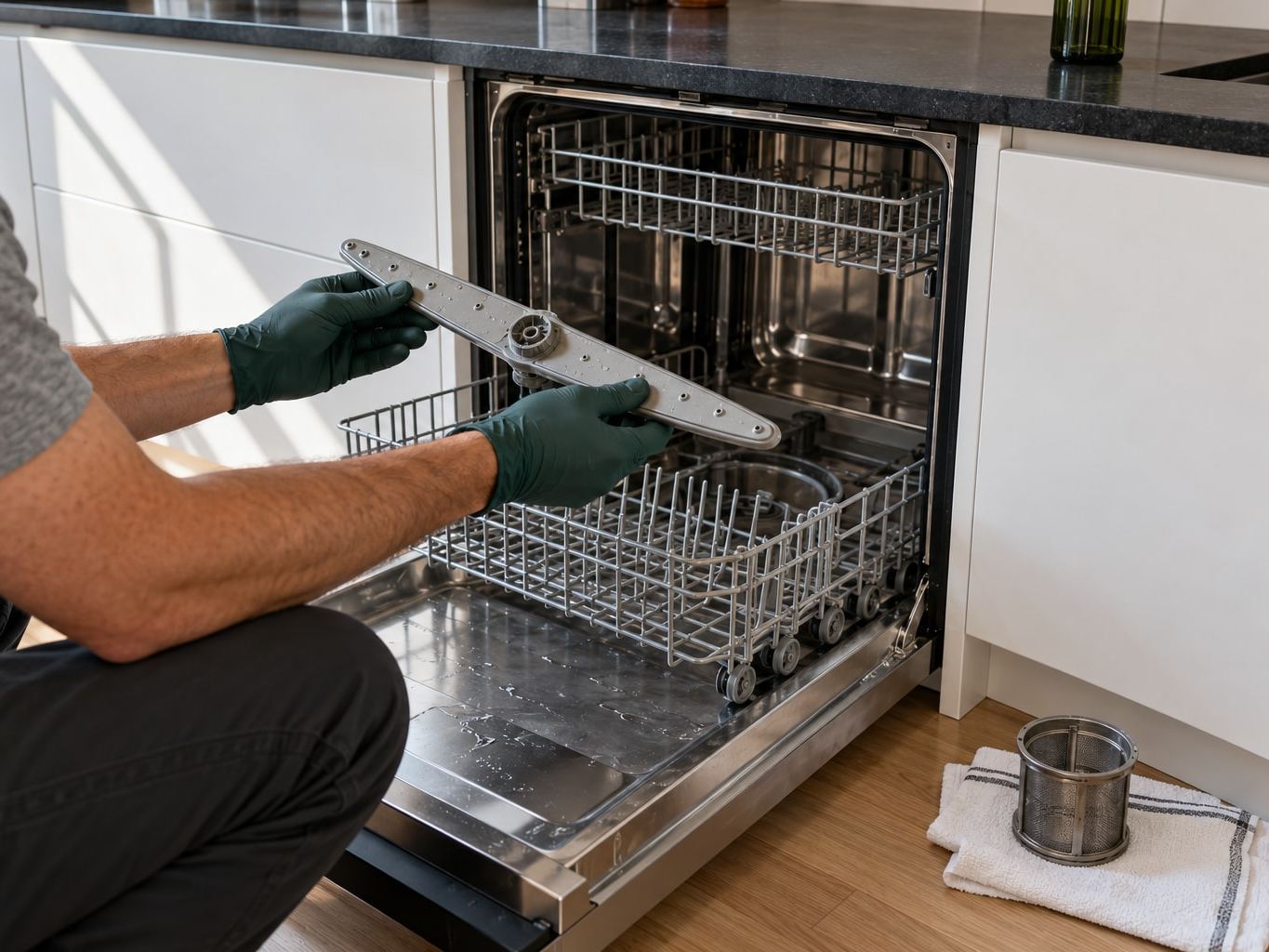
Owner checks that are safe to try first
These few steps either cure the trouble outright or shorten our visit. Anything past them, in particular behind the toe kick or beneath the tub, belongs to the technician.
- Slide the lower rack out, unscrew the filter cup, and rinse it at the faucet. A clogged cup is the most frequent reason for sluggish draining and dull dishes.
- Unclip the bottom spray arm and look through its nozzles toward a lamp. A wooden toothpick frees food bits; white scale loosens after an hour in plain vinegar.
- If a small chrome cap sits beside the faucet, that is the air gap. Twist the cap off and clear out whatever has collected inside.
- Make sure the garbage disposal is empty, and if it was installed recently, ask whether the plastic knockout inside its dishwasher inlet was ever punched out.
- Ease up on loading. Big pots in the front corners can pin the detergent lid shut and stop the upper arm from turning.
- When water reaches the floor, close the small supply valve in the sink cabinet, flip the dishwasher breaker off, and lay down towels. A leak that will not stay stopped can be reported through our urgent repair page.
- Photograph the rating sticker with model and serial along the door rim or tub edge, and jot down at which stage things went wrong, which lets us load matching parts before driving over.
Quick answer · last stop
Is a Viking dishwasher leaking from the door serious?
Treat it as soon-not-someday. A few drops along the door bottom usually mean a flattened seal or a door that has sagged, a fairly simple fix. Water creeping out from beneath the machine suggests a hose, fitting or pump seal, and that can rot a subfloor and swell cabinet panels. Close the supply valve and phone us.
Before you rinse another load by hand
- There is still water sitting in my Viking after the cycle. Is it okay to keep using it?
- Rinse the filter cup and try a single program. If the sump fills up again, give the machine a rest: a pump laboring against a blockage can cook its own motor, and stale water starts to smell within a day or two. We trace the clog to the pump, hose or air gap and clear or replace that piece.
- My Viking dishwasher is not new. Does a repair still make sense?
- In many kitchens it does. Pumps, solenoid valves, door seals, latches and arms are all serviceable, and the stainless tub and racks tend to outlive them. Once the machine is tested, you hear what the job involves and what it will cost, and the choice stays yours. When a replacement is the wiser use of money, we tell you that straight.
- How much should I budget to fix a Viking dishwasher?
- Coming out costs $89; say yes to the fix and those dollars fold into it. Parts and labor vary from one fault to the next, so the firm number comes after testing, always before work starts. See how our pricing works for the factors that shape it.
- Can one visit cover both the dishwasher and my Viking fridge?
- Absolutely. $89 is charged once per trip rather than per machine, so the same technician can inspect the dishwasher, the Viking refrigerator and any other Viking appliance in one stop. Mention both machines when booking so the visit is planned for both.
- Will you come to a Viking dishwasher outside Lincoln Park?
- Our area is Lincoln Park, Lakeview, Wrigleyville, DePaul, Old Town, Bucktown and Wicker Park. Long drain runs can slow the outflow test, so in a loft conversion in Bucktown or an older two-flat we check the whole hose route, not just the pump. Living a few blocks past that map? Ring (872) 250-5505 and get a straight yes or no.