Repair line, Viking repair
Viking range won't light or won't heat? Repair starts here
Is a burner ticking with no flame, or is the oven sitting cold while dinner waits? On a Viking range either problem has a short list of suspects, from igniters and spark modules to a safety valve, an element or a relay, and the visit is spent testing that list in order instead of ordering parts on a guess. You pay $89 per trip, not per machine, and that sum is later folded into the repair bill.
Rated 4.8 out of 5 by clients, 143 reviews How reviews work
If you smell gas
Gas smell near the range? Leave first, call second
Should the kitchen pick up a sulfur or rotten-egg odor, keep your hands off the range entirely, including its dials, the shutoff, wall switches and anything that sparks. Leave the building, bring people and pets along, and phone 911 or the utility once you are standing outdoors. After responders clear the house, ring (872) 250-5505 so a technician can pin down where on the appliance it came from.
Quick answer · first stop
My Viking range burner clicks but won't light: what's wrong?
That ticking means current reaches the electrode; ignition still needs gas meeting a clean spark in the right spot. Typical culprits: a cracked or grimy igniter, ports gummed up by spilled sauce, a cap resting askew, a weakening spark module or a burner valve that sticks. Each gets ruled in or out on site, so nobody swaps an igniter on a hunch.
Six range symptoms and the parts behind them
Some symptoms belong to the cooktop, some to the oven, and a few to the gas and electrical parts the two halves share. Sorting them early tells us what to test first.
-
Burners click but will not catch, or the flame burns weak and yellow
Likely causeCooktop: an igniter, clogged ports, a misplaced cap or a tired spark module. The same sealed burners are covered in depth on our cooktop page.
-
Cookies scorch along one edge of the pan while the opposite edge stays blond
Likely causeDownstairs trouble: a tired bake igniter or element, a sluggish convection fan, or a door seal letting heat slip out.
-
A whiff of gas lingering by the range with all burners off
Likely causeA loosened fitting or a hardened seal at a burner or valve. Safety comes before any repair talk here.
-
The oven never climbs to the temperature you set
Likely causeWith all-gas models, an oven igniter glowing orange yet drawing too little current for the safety valve to open; with dual-fuel and electric ones, a burned element, a relay or the sensor.
-
Knobs spin loosely, stick, or will not return cleanly to off
Likely causeWorn knob inserts, or a valve stem stiffened by heat and grease. A burner valve that does not close cleanly is a safety problem, not a cosmetic one.
-
Self-clean refuses to begin, or the latch holds the door shut long after
Likely causeThe latch motor, the switch reporting its position, a thermal fuse blown by cleaning heat, or the main board.
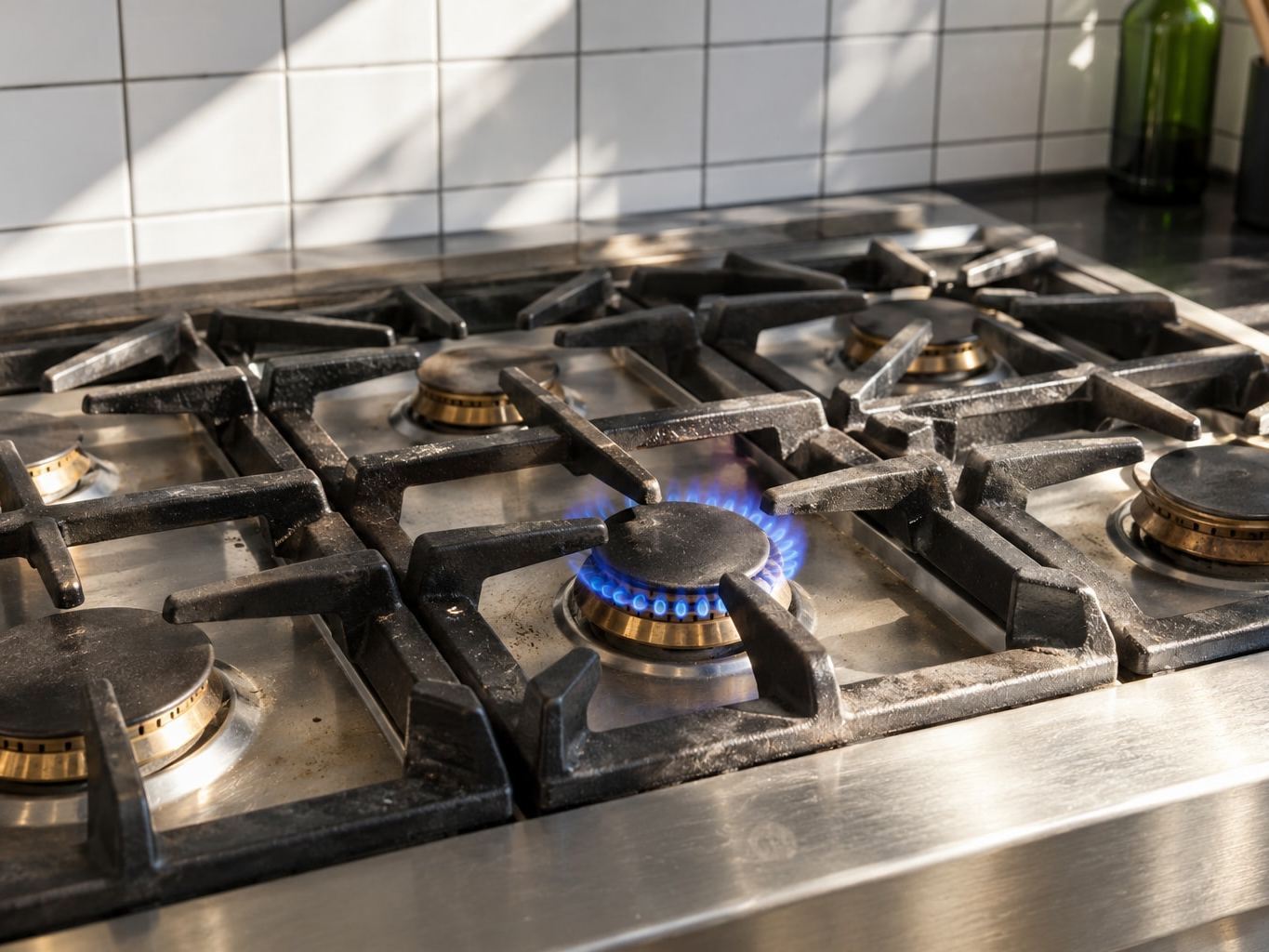
Gas, dual-fuel or electric: how the fuel changes the repair
We service Viking Professional ranges (7 Series and 5 Series) and 3 Series ranges in all-gas and dual-fuel form, and electric Viking ranges as well. The fuel feeding the burners and the oven decides which parts can fail and how they get tested.
| Part of the range | All-gas | Dual-fuel | Electric |
|---|---|---|---|
| Cooktop | Sealed brass burners, spark igniters, spark module, burner valves | The same gas burners and spark system as an all-gas range | Radiant elements or induction zones and the switches behind them |
| Oven | Gas bake and broil burners, their igniters and the oven safety valve | Electric bake, broil and convection elements on their own circuit | Electric elements, convection fan and temperature sensor |
| Supply it depends on | A gas line plus a standard outlet for spark, lights and controls | A gas line for the top and a heavy electrical circuit for the oven | A dedicated heavy electrical circuit |
| First suspect when the oven stays cold | The oven igniter that glows but cannot open the valve | An element, or the oven relay on the control board | An element, a burned wire terminal or the sensor |
| Checks before we pack up | Soap-and-gauge leak check on disturbed fittings, flame look at each burner | Leak test on the gas side, voltage check on the oven side | Voltage and insulation checks on elements and wiring |
Quick answer · transfer
Why does my Viking range oven not heat when the burners work?
Because the two halves fail independently. The burners light by spark, while the oven relies on its own igniter and safety valve on all-gas models, or its own elements and relay on dual-fuel models. Working burners therefore prove only that gas and power reach the range. The search starts inside the oven, not on the cooktop.
How a range visit runs, from the grates down
The order is deliberate: we clear the burners and the gas side first, because a wrong guess on gas parts is the costly kind of mistake. One Viking Professional range in our case notes had an igniter failure that left it with no heat; the fix was a new dual igniter assembly and a recalibrated gas valve. For the problems we tend to see as Professional ranges age, read typical Viking Professional range problems.
Burners and ignition
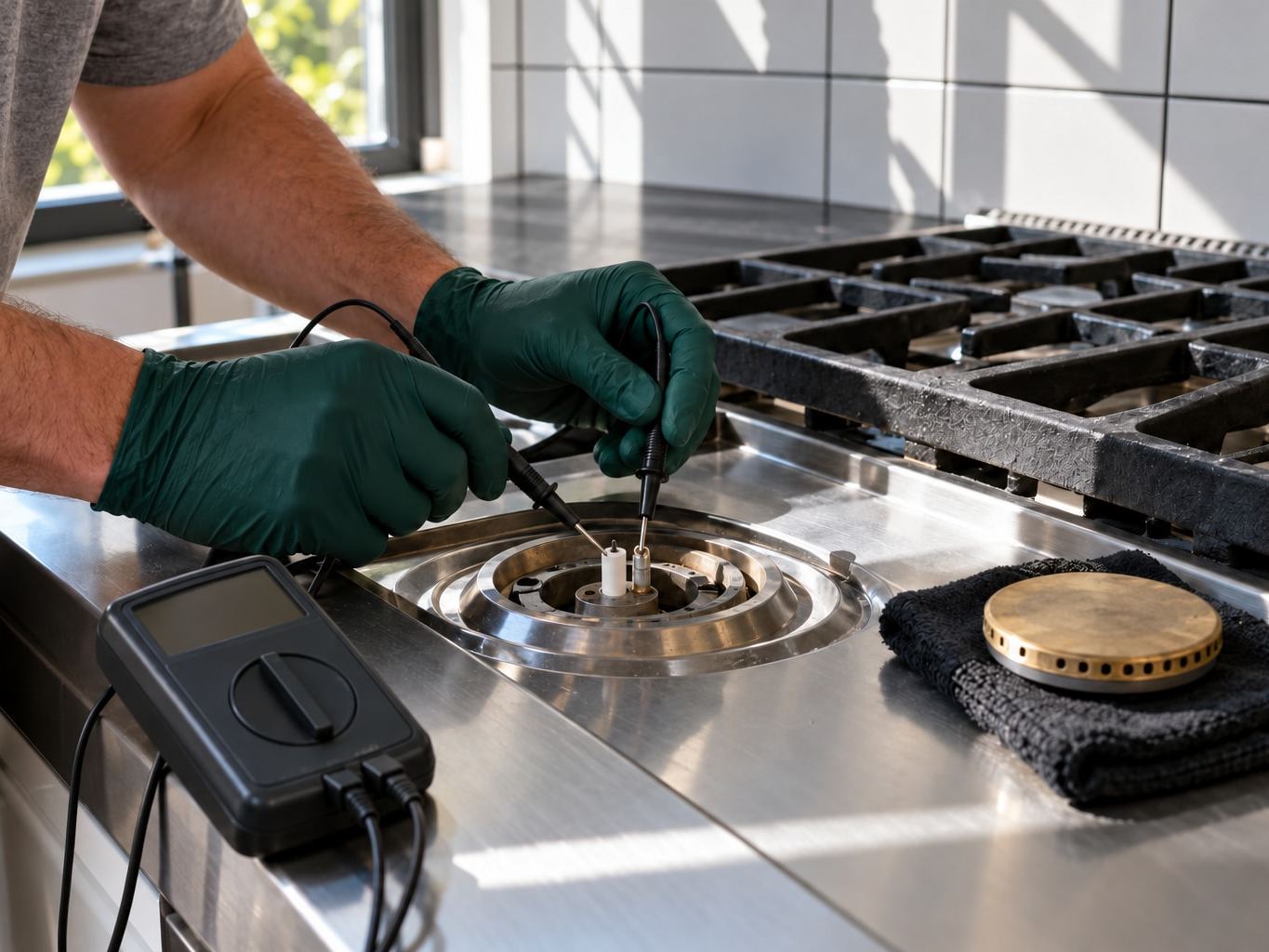
Each burner is lit on its own. We watch flame shape and color, listen to the spark, lift the caps to inspect the ports and the igniter, and check the connections under the cooktop.
Oven temperature
A separate thermometer goes on the middle rack and is compared with the setting through a full heating cycle. If the oven drifts, we trace the cause instead of simply offsetting the dial.
Control board and wiring
Stored error codes, relays, clock and mode functions, and the wire terminals that slowly cook behind a hot range.
Door, hinges and latch
A sagging door or a flattened gasket leaks heat, throws off baking and can stop self-clean from locking. We check how the door closes, the hinges and the lock mechanism.
Gas pressure and safety parts
Regulator and supply pressure, the response of the oven safety valve, and a leak test on every fitting we opened during the visit.
A full run before we leave
All burners together, the oven through bake and broil, then a walk-through with you at the range so you know what was replaced and why.
Quick answer · last stop
Who repairs Viking dual-fuel ranges in Chicago?
Lakefront Appliance Works handles Viking dual-fuel, all-gas and electric ranges based out of Lincoln Park, covering Lakeview, Old Town, Bucktown and nearby blocks. Someone picks up the phone 24/7; technicians are out 8 AM–6 PM daily. The $89 call-out is credited to the bill, and you approve a firm quote once the range has been diagnosed.
Clicking does not always mean a dead igniter
-
Often heard
If a burner clicks and will not light, the igniter is bad.ActuallyClicking shows the spark is being sent. The igniter may be cracked, but just as often a port is clogged, the cap sits crooked, the spark module fires weakly or the burner valve is sticking. Replacing the igniter first can mean paying for a part you did not need.
-
Often heard
A range with no oven heat needs a new control board.ActuallyBoards do fail, but they are the last suspect, not the first. On the Professional range in our notes, no heat came down to the dual igniter and the gas valve setting. When a board really is in question, check the connections first: our five memorable repairs include a 2008 dual-fuel range where a corroded ribbon cable connector, not the board, was the fault.
-
Often heard
Running self-clean is the gentlest way to deal with a dirty oven.ActuallyThe cleaning cycle drives the oven far hotter than any recipe. That heat is what trips thermal fuses and strains door locks on older ranges. If your self-clean has been fussy, tell us when you call.
What range owners ask us on the phone
- Can a Viking range normally be fixed in one trip?
- Usually, yes. If a component must come from a supplier, you hear its name, the reason it is required and the total for the job before anything is ordered, and a second stop wraps things up. Arrival windows are given when you schedule, not promised on a web page.
- Can I keep using my cooktop burners while the oven half is dead?
- Generally, provided each burner catches promptly, every flame burns crisp and blue, and nothing smells off. Any doubt about the gas side means switching to the safety advice in the red box near the top here.
- Do you repair both gas and dual-fuel Viking ranges?
- Yes, and electric ones too. Professional ranges, including the 7 Series and 5 Series, and Designer and 3 Series ranges are all work we do. We service Viking appliances only.
- Should I replace the range igniter myself?
- On a gas range we advise against it. The oven igniter is part of the safety circuit that decides when gas is allowed to flow, and a wrong part or a loose connection can leave the oven unsafe. Cleaning burner caps and ports with a soft brush, once the range is cold, is a reasonable job to do yourself.
- Is the $89 charged twice if both the oven and the burners need work?
- No. That $89 pays for getting a technician to your door, so the burners, the oven and even a weak hood overhead all fall under one call-out, later credited to the work. More on hoods at Viking ventilation repair; the whole fee logic sits on our pricing page.
- How should I prep the kitchen for a range visit?
- Empty the grates and racks, and give us an arm's length of open floor before the oven door. A snapshot of the rating plate with model and serial numbers is handy; look along the oven door frame or behind the kick panel at floor level. Can't locate it? No problem, we will.