Repair line, Viking repair
Viking oven repair when the dial and the heat disagree
Pale loaves, scorched edges, a roast that needs another half hour: when a Viking oven bakes like that, the number on the dial and the heat in the cavity have drifted apart. Our job is to measure that drift, locate its source among sensor, igniter, element, fan, gasket and board, and close it.
Rated 4.8 out of 5 by clients, 143 reviews How reviews work
Quick answer · first stop
Why is my Viking oven temperature not accurate?
Inaccurate heat usually traces to a temperature sensor whose resistance has wandered, a weakened igniter on gas models or a failing element on electric ones, a gasket leaking heat around the door, or a convection fan spinning slowly. Recalibration helps only after the underlying fault is repaired. We verify with an independent thermometer before replacing anything.
Six ways an oven tells you it has drifted
Single wall units, stacked doubles and range cavities from Viking give off a familiar set of clues. Every clue implicates its own link in the heating chain.
-
Bread and cakes stay pale, or bake far slower than the recipe expects
Likely causeThe cavity runs under its setting: a sensor reading high, a sluggish bake igniter on gas units, or a bake element losing output on electric ones.
-
Heat surges and sags during one bake
Likely causeA sensor or control fault, or a door seal leaking so badly the oven keeps cycling hard to catch up.
-
The gasket looks torn or flattened, or light shows around a closed door
Likely causeGasket wear, or hinges letting the door droop so heat escapes along the top or sides.
-
On a gas oven, the igniter glows orange yet the burner never ignites
Likely causeAn igniter that has aged until it no longer pulls enough current to open the oven safety valve.
-
You select convection, yet the fan stays quiet, ticks or grinds
Likely causeDry motor bearings, a blade slipping on its hub, or the board circuit powering that motor.
-
Letters or numbers flash on the screen, or touch pads ignore your finger
Likely causeThe control board itself, a sensor reporting out of range, or a wiring fault the board is flagging.
What happens at the oven, stage by stage
Every oven visit moves from measuring to fixing, never the reverse. Stages, not stopwatch times:
- Measure
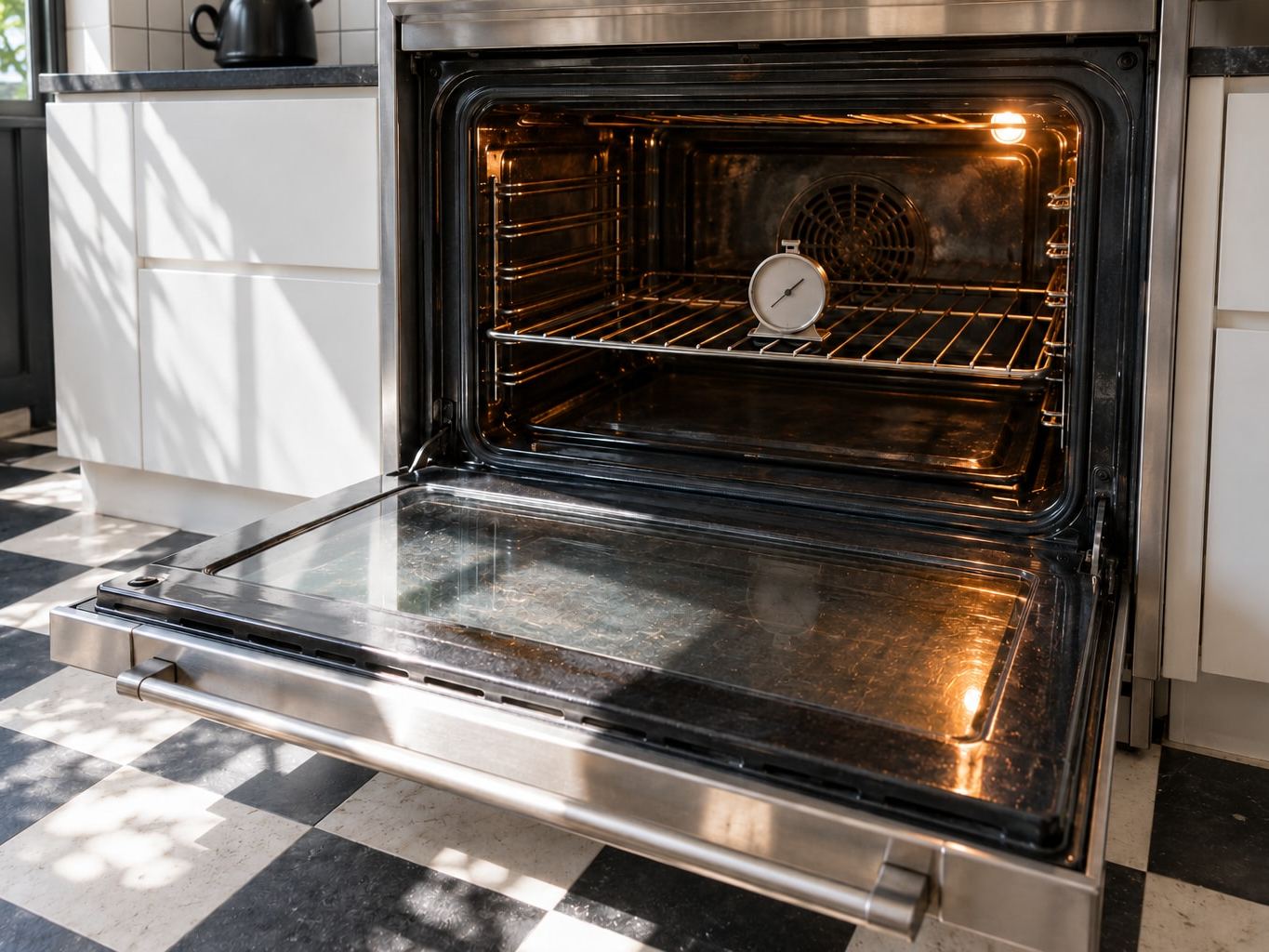
- An independent thermometer sits on the center rack through one complete heat-up and cycling period, so the real cavity temperature can be compared with the setting rather than with anyone's memory of how it used to bake.
- Heat sources
- Bake and broil elements on electric ovens, igniters and burners on gas ones, each checked for resistance and current draw against the values they should show.
- Convection
- Motor, fan blade and the circuit feeding them, so air reaches every rack position evenly instead of pooling at the back.
- Door
- Gasket, hinges and closure. A leaking seal can mimic a bad sensor almost perfectly, which is why it gets its own stage.
- Control board
- Stored fault codes, live sensor readings and relay output, read before any board is condemned.
- Proof run
- Once the fault is fixed and any calibration is set, the oven heats again with the thermometer inside, and you see the two numbers line up.
Quick answer · transfer
Why won't my Viking self-clean start, and why is the door still locked?
Self-clean relies on a motorized latch, a switch confirming the latch has closed, and a thermal fuse guarding against overheating. When the latch motor or switch fails, the cycle never begins or the door stays locked; when the fuse blows, the oven may lose heat altogether. Never force the door. Let it cool completely, then call.
What moves the price of an oven repair
Ovens have no fixed menu. The trip is $89, credited to the bill, and you approve an exact figure after diagnosis, before work starts. Details on our pricing page. These are the variables:
Which component failed
Swapping a sensor, gasket or igniter costs far less effort than replacing a convection motor or main board.
Access inside the cabinetry
A single wall oven comes out differently from a double oven stacked in a tall cabinet. Some repairs mean easing the unit forward and supporting its weight.
Stocked or special-order
Frequently needed pieces tend to arrive fast; unusual Viking components take ordering. You learn which applies before agreeing.
A possible return trip
Ordered components mean we come back to install them. We flag that at diagnosis, so it never surprises you later.
Calibration and proof run
Any fix touching temperature closes with calibration plus a heat run, already included in the figure you sign off on.
Things to note on the oven before the visit
Jot these down; they make our testing quicker and steer which parts travel with the technician.
- How far off it seems: slightly slow, or badly underdone or burnt
- Roughly when trouble began, and anything that coincided: an outage, a cleaning cycle, a new spray cleaner
- With stacked doubles, top cavity, bottom cavity, or both
- Which modes are affected: bake, broil, convection, self-clean
- Any screen code, copied letter for letter
- Model and serial from the data plate, often found along the frame once you open the door
Case notes: one cavity of a double oven drifting
A job from our files shows why we measure before we touch anything. The upper cavity of a Viking double oven was about 50 degrees off its setting. Each cavity of a double oven has its own temperature sensor, so the search could start with the upper oven's own parts rather than everything the two cavities share.
The fix recorded for that oven was short: a new temperature sensor, then calibration, so the upper cavity once again matched the number on its dial.
The lesson is not that sensors always fail. It is that ovens get tested rather than guessed at, and that in a double oven each cavity gets checked on its own. Our article on how we diagnose walks through that thinking in more depth.
If your oven sits beneath a set of burners, it is part of a range, and the cooktop half lives on the same frame; Viking range repair explains how we split the work between them. Wall ovens get the same visit anywhere in our area, from Old Town to Wicker Park.
Quick answer · last stop
Why is the upper oven of my Viking double oven not heating?
Each cavity in a Viking double oven has its own elements or burner, its own sensor and its own circuit on the control board, so one can quit while the other keeps baking. Frequent findings include a burned bake element or igniter, a faulty sensor, or a dead relay on the board. Using the working cavity until the visit is generally fine.
Oven questions, answered plainly
- My Viking oven runs hot or cold; is that fixable?
- Yes. First we establish why it drifts, whether sensor, heat source, gasket or board, then repair that, recalibrate and prove the result with a thermometer. Calibrating without fixing the cause tends to let the oven wander off again.
- How much does Viking oven repair cost?
- Expect $89 for us to show up; a fridge or dishwasher checked during that same stop adds nothing to it, and the sum is subtracted from your repair total. Beyond that, parts and labor vary job to job, so you get a written number once we know what broke, never mid-repair.
- Should I still bake in an oven that overheats?
- Hold off if it overshoots badly, smokes, or the door latch behaves oddly. An oven that is only a little slow can be used with a hanging oven thermometer until we arrive.
- Can I book an oven repair online?
- Sure. Use online scheduling or dial (872) 250-5505, answered 24/7, with house calls 8 AM–6 PM daily. If you'd like to explain symptoms first, our contact page gathers phone, booking and service-area details.